Networking
Overview
KorGrid's network fabric provides integrated, software-defined networking (SDN) to your environment, enabling the creation of logical networks independent of physical infrastructure. With the fabric, you can create and manage virtual networks on demand and deploy networks instantly, without complicated configurations or reliance on networking specialists.
Key Features
Integrated SDN Functionality
- Native to the platform – No extra hardware or appliances required
- Centralized Management – Manage all networking components within a unified interface, alongside the hypervisor and storage controls
- Embedded IP Administration - DHCP, DNS, routing, and firewall functionality built-in
- Dynamic Routing – BGP/OSPF support for advanced networking capabilities
Advanced Security & Segmentation
- Micro-segmentation – Enforce security at the tenant level or down to individual VMs with dedicated internal networks
- Distributed Firewall (DFW) – Applies granular security rules inside the network, beyond traditional perimeter-based controls
- Built-in Monitoring & Diagnostics – Track and control network performance with rate limiting, logging, and integrated diagnostic tools
Automation & Orchestration
- API-First Networking – Fully programmable networking via REST APIs
- Self-Service Networking – Developers can deploy, modify, and manage virtual networks without IT intervention
- Task Engine Integration – Automate networking tasks based on scheduling or event triggers
Multi-Cloud & VPN Support
- Multi-cloud Design – Securely connect multi-tenant environments and multiple sites
- VPN Integration – Site-to-Site and Client VPN access using WireGuard or IPsec
Network Types
External Networks
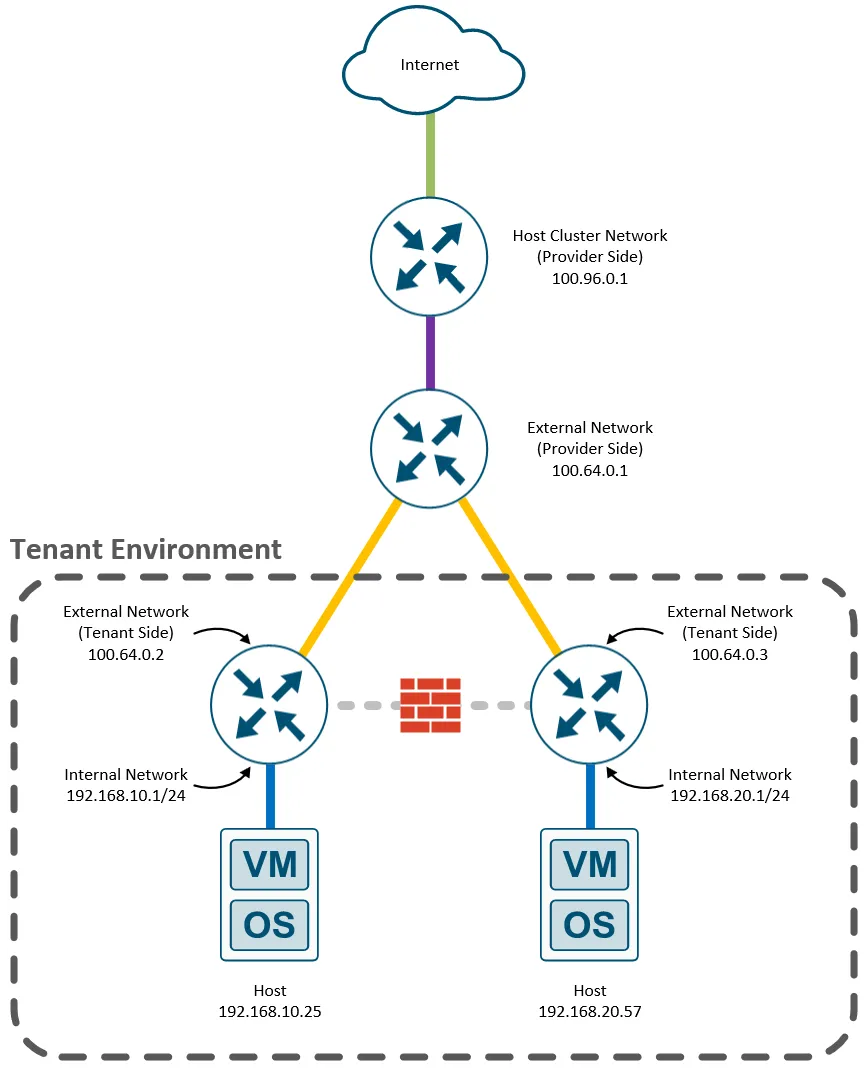
Connects your tenant to the outside world. Think of this network as your ISP connection.
Common use cases:
- Internet connectivity - Provide external access for workloads
- Multi-site connectivity - Link to other KorGrid regions
Internal Networks
Create isolated virtual networks within your tenant for workload segmentation and security.
Common use cases:
- Application tiers - Separate web, application, and database layers
- Development environments - Isolated networks for dev/test workloads
- Tenant isolation - Dedicated networks for multi-tenant deployments
VPN Networks
Establish secure tunnels for remote access and site-to-site connectivity.
Common use cases:
- Remote user access - Secure connectivity for distributed workforce
- Branch office connectivity - Site-to-site VPN between locations
- Partner access - Controlled external access to specific resources
Traffic Flow
The following diagram helps to illustrate traffic flow within the platform.